
Mastering the NBA Bracket: Your Ultimate Playoff Guide
Understanding the NBA bracket is key to enjoying basketball postseason drama. Sixteen teams fight through four rounds of intense action to win the Larry O’Brien Trophy. From regular-season seedings to final buzzer-beaters, every single game changes the bracket path.
This guide breaks down every step of the postseason system. You will learn how teams qualify, how home-court advantage works, and how to fill out a winning bracket prediction sheet.
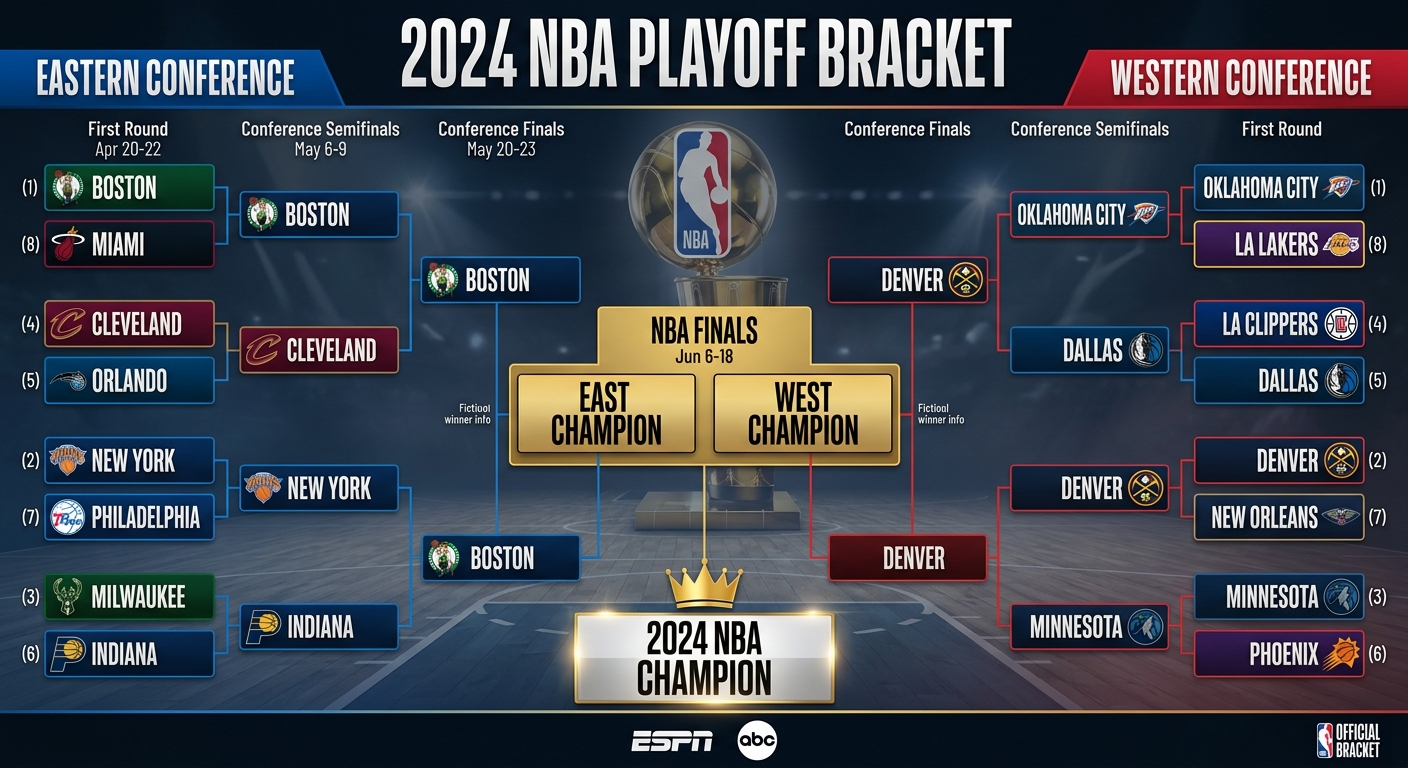
WESTERN CONFERENCE EASTERN CONFERENCE
Round 1 Semis Finals FINALS Finals Semis Round 1
[#1] ──┐ ┌── [#1]
├──┐ ┌──┤
[#8] ──┘ │ │ └── [#8]
├──┐ ┌──┤
[#4] ──┐ │ │ │ │ ┌── [#4]
├──┘ │ │ └──┤
[#5] ──┘ │ │ └── [#5]
├── WEST WINNER ──┐ ┌── EAST WINNER ┤
[#3] ──┐ │ │ │ │ ┌── [#3]
├──┐ │ ▼ ▼ │ ┌──┤
[#6] ──┘ │ │ [NBA FINALS] │ │ └── [#6]
├──┘ └──┤
[#2] ──┐ │ │ ┌── [#2]
├──┘ └──┤
[#7] ──┘ └── [#7]
Postseason Tournament Overview
| Category | Details |
| League | National Basketball Association (NBA) |
| Postseason Format | Play-In Tournament + 16-Team Bracket |
| Total Qualified Teams | 20 Teams (10 Per Conference: Seeds 1-6 Direct, Seeds 7-10 Play-In) |
| Playoff Format | 4 Rounds, Best-of-7 Series (2-2-1-1-1 Format) |
| Defending Champions | New York Knicks (2026 Champion), Oklahoma City Thunder (2025 Champion) |
| Primary Goal | Win 16 Postseason Games to Secure the Larry O’Brien Trophy |
How the Play-In Tournament Shapes the NBA Bracket
The Play-In Tournament locks in the final playoff seeds. Teams finishing 7th through 10th in each conference enter a short tournament before the main postseason opens.
- Seventh vs. Eighth Seed: The 7th-place team hosts the 8th-place team. The winner takes the official #7 seed in the main bracket.
- Ninth vs. Tenth Seed: The 9th-place team hosts the 10th-place team. The loser is eliminated immediately.
- Final Battle for #8 Seed: The loser of the 7 vs. 8 match plays the winner of the 9 vs. 10 match. The winner grabs the final #8 seed.
This tournament gives bottom-tier playoff hopefuls a final shot while keeping late regular-season games highly competitive.
Eastern Conference vs. Western Conference Setup
The NBA split forces teams to fight through their own conference first. The Eastern Conference and Western Conference operate identical bracket tracks.
Eight teams from the East and eight teams from the West fill out two separate sides of the tournament sheet. A team from the West cannot play an Eastern team until the NBA Finals. This divisional division builds regional rivalries across all four postseason rounds.
First-Round Matchup Rules and Seedings
Once seeds 1 through 8 are settled in both conferences, the first round begins with structured matchups. Higher seed numbers reflect better regular-season records and earn home-court advantage.
The standard first-round match pairings are:
- Matchup 1: #1 Seed vs. #8 Seed
- Matchup 2: #2 Seed vs. #7 Seed
- Matchup 3: #3 Seed vs. #6 Seed
- Matchup 4: #4 Seed vs. #5 Seed
No re-seeding occurs in later rounds. The winner of #1 vs. #8 automatically faces the winner of #4 vs. #5 in the second round.
The Best-of-Seven Series Format Explained
Every series inside the official nba bracket 2026 uses a best-of-seven format. The first team to win four games advances to the next round, while the losing team is eliminated.
Games follow a 2-2-1-1-1 court schedule:
- Games 1 & 2: Played at the higher-seeded team’s home arena.
- Games 3 & 4: Played at the lower-seeded team’s home arena.
- Game 5 (If needed): Higher-seeded home arena.
- Game 6 (If needed): Lower-seeded home arena.
- Game 7 (If needed): Higher-seeded home arena.
Home-court advantage gives top-performing regular-season teams host priority for crucial deciding games.
Conference Semifinals: Narrowing Down the Elite
The Conference Semifinals cut the field down from eight teams per conference to four. Only the most resilient rosters survive this second-round test.
During this stage, tactical adjustments become vital. Head coaches alter rotation minutes, study film, and build game plans around opponent weaknesses over seven grueling matches. Winning here seals a spot in the regional championship series.
Conference Finals: The Battle for Championship Spots
The Conference Finals determine the champions of the East and West. The final two teams in each conference play for regional trophies—the Bob Cousy Trophy in the East and the Oscar Robertson Trophy in the West.
The intensity peaks during these series. Superstar performers often carry heavy workloads as teams clash for the right to represent their conference on the league’s grandest stage.
The NBA Finals: Crowns and Championship Glory
The ultimate climax of any nba bracket is the NBA Finals. The Eastern Conference champion faces the Western Conference champion in a final seven-game series.
Home-court advantage in the Finals goes to the team with the better regular-season record, regardless of their seed number. The winner claims the Larry O’Brien Trophy, while the individual star performer wins the Bill Russell Finals MVP Award.
Strategy Tips for Filling Out Your Bracket Challenge
Filling out a tournament bracket pool requires balancing logic with smart risk-taking. Here are key tips to build a better sheet:
- Protect Top Seeds: Number 1 and 2 seeds win first-round matchups over 85% of the time. Avoid picking early upsets for top overall teams.
- Watch the 4 vs. 5 Matchup: The #4 vs. #5 series is almost always a coin flip. Pick the team entering April with better health and momentum.
- Evaluate Late-Season Health: Injuries to star players right before April ruin potential title runs. Always check team medical reports before locking picks.
- Favor Defensive Ratings: Teams with top-10 defensive ratings handle high-pressure playoff games better than pure jump-shooting teams.
Historical Bracket Upsets That Shocked Basketball
While higher seeds usually win, legendary upsets occasionally shake up the playoff field:
- 1994 Denver Nuggets: Became the first #8 seed in history to defeat a #1 seed by beating the Seattle SuperSonics.
- 1999 New York Knicks: Reached the NBA Finals as an #8 seed during a lock-out shortened season.
- 2007 Golden State Warriors: The “We Believe” Warriors knocked off the 67-win Dallas Mavericks in six games.
- 2023 Miami Heat: Made a run from the Play-In Tournament all the way to the NBA Finals as an #8 seed.
Conclusion: Get Ready for Postseason Action
Understanding how the playoff sheet works helps you follow every game with clearer insight. From the opening games of the Play-In Tournament down to Game 7 of the Finals, the postseason tests depth, health, and strategy.
Get your printable bracket ready, track seed movements during the regular season, and enjoy the battle for championship glory!
Frequently Asked Questions (FAQs)
How many teams make the official playoff bracket?
Sixteen teams make the primary playoff bracket—eight from the Eastern Conference and eight from the Western Conference. Four additional teams participate in the pre-playoff Play-In Tournament.
Does the NBA re-seed bracket teams after the first round?
No, the NBA does not re-seed teams. Bracket matchups follow fixed paths set before the postseason starts. The winner of the 1 vs. 8 series always plays the winner of the 4 vs. 5 series in the second round.
What happens if two teams finish with the same regular-season record?
Tiebreakers determine seedings. The league looks at head-to-head records first, followed by division winner status, division record (if in the same division), conference record, and conference record against playoff teams.
How does home-court advantage work in the postseason?
Home-court advantage goes to the team with the higher seed in the first three rounds. In the NBA Finals, it goes to the team with the superior regular-season winning percentage.
How long does the entire NBA postseason last?
The postseason runs for about two months. It starts in mid-April with the Play-In Tournament and ends in mid-June with the completion of the NBA Finals.
What is the difference between the Play-In Tournament and the Playoffs?
Play-In games determine the final 7th and 8th seeds in each conference. Player stats in Play-In games count toward special tournament records rather than official regular-season or playoff statistics.