
At first glance, mirror-testing sounds simple—just looking into a mirror. But in science, psychology, and even product development, mirror testing can reveal surprisingly deep insights about behavior, perception, and self-recognition.
Depending on the field, the term can describe everything from testing animal intelligence to evaluating a product’s symmetry or helping people reflect on their own emotional state. Understanding mirror-testing gives you a clearer picture of why this concept appears in so many different industries.
What Is Mirror-Testing?
Mirror-testing generally refers to a method of using a reflection to evaluate recognition, performance, or accuracy.
The exact meaning depends on context:
- Psychology: measuring self-recognition
- Animal research: assessing awareness
- Design: checking symmetry or visual balance
- Software: comparing systems against identical environments
- Personal growth: evaluating self-perception
The most famous version is the mirror test in behavioral science, where researchers study whether an animal recognizes its own reflection.
The Origin of Mirror Testing in Psychology
The modern idea of mirror testing became widely known after psychologist Gordon Gallup Jr. introduced the mirror self-recognition test in 1970.
The goal was to answer one fascinating question:
Can a subject recognize itself in a mirror?
Researchers place a harmless mark on an area the subject cannot normally see. If the subject uses the mirror to inspect or touch the mark, that may suggest self-recognition.
How Mirror Testing Works
The basic process
A standard mirror-testing experiment usually follows these steps:
- The subject is exposed to a mirror
- A visible mark is placed on the body
- The subject sees its reflection
- Researchers observe the response
- Behavior is analyzed for self-recognition
A positive result occurs when the subject appears to understand:
“That reflection is me.”
Mirror Testing in Animals
One of the most discussed uses of mirror testing is in animal cognition.
Animals that may pass mirror tests
Some species have shown signs of self-recognition, including:
- Chimpanzees
- Dolphins
- Elephants
- Magpies
Scientists use these findings to explore consciousness and intelligence.
Animals that often fail
Many animals do not pass, including:
- Dogs
- Cats
- Most birds
- Fish
That does not automatically mean they lack awareness—only that mirrors may not be the best way to measure it.
Mirror-Testing Beyond Psychology
The phrase mirror-testing is also used in practical industries.
Mirror Testing in Product Design
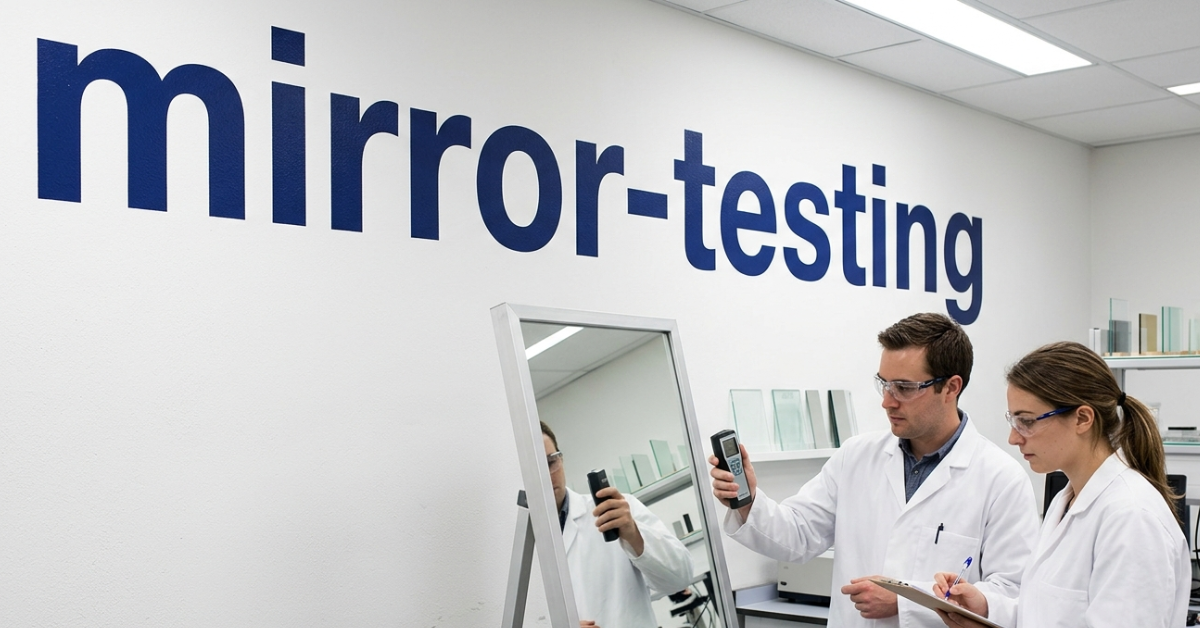
Manufacturers use mirror testing to inspect:
- Symmetry
- Surface defects
- Alignment
- Finish quality
For example, automotive designers may examine a part’s reflection to detect flaws invisible at first glance.
Mirror Testing in Software Development
In technology, mirror testing can mean comparing two nearly identical systems.
Developers may use it to:
- Compare server performance
- Validate updates
- Detect bugs
- Ensure consistency
It works like holding one system up against another “mirror” version.
Mirror Testing for Personal Reflection
Some people use informally as a self-awareness exercise.
Standing in front of a mirror can help with:
- Public speaking practice
- Body language improvement
- Confidence building
- Emotional reflection
It sounds simple, but it can reveal habits people usually miss.
Why Mirror-Testing Matters
It matters because it helps answer deeper questions.
It can reveal:
- Self-awareness
- Behavioral patterns
- Product flaws
- Communication issues
- System inconsistencies
That is why it remains valuable across multiple disciplines.
Common Misunderstandings About Mirror Testing
There are a few common myths around.
Myth 1: Passing proves intelligence
Not necessarily. It only suggests one form of awareness.
Myth 2: Failing means no awareness
False. Some species rely more on smell or sound than sight.
Myth 3: It only applies to animals
It has uses in design, software, and self-development too.
Signs Mirror Testing Can Be Useful
It may help when you need to evaluate:
- Visual perception
- Self-recognition
- Presentation skills
- Product quality
- Behavioral responses
It is often a simple method that can uncover complex insights.
Limitations of Mirror-Testing
Despite its usefulness, it has limits.
Key limitations include:
- Cultural bias in human studies
- Species differences in senses
- Subjective interpretation
- Overreliance on visual cues
Some experts argue the classic mirror test may miss other forms of intelligence.
Mirror-Testing in Everyday Life
You may already use in without realizing it.
Examples include:
- Checking posture before an interview
- Practicing a speech
- Inspecting clothing fit
- Evaluating facial expressions
These everyday moments use the same basic principle:
reflection reveals information.
Read also <<< How to Grind Coffee Beans
FAQs About Mirror-Testing
What is mirror-testing?
It is a method of using reflection to assess self-recognition, performance, or accuracy.
What is the this test in psychology?
It is a behavioral test used to determine whether a subject recognizes itself in a mirror.
Why do scientists use this test on animals?
They use it to study self-awareness and cognitive ability.
Can humans use testing?
Yes. People often use it to improve confidence, body language, and communication.
Does failing this test mean low intelligence?
No. It simply means the test may not measure that individual’s awareness effectively.
Conclusion
Mirror-testing may seem straightforward, but it offers powerful insights into awareness, behavior, and accuracy. From psychology labs to design studios to personal growth routines, it helps reveal things that might otherwise stay hidden.
Whether you are studying cognition or improving your own presentation skills, the mirror can be more than just glass—it can be a surprisingly effective tool for understanding what is really there.
If this topic interests you, exploring related subjects like self-awareness research or behavioral science can take your understanding even further.