
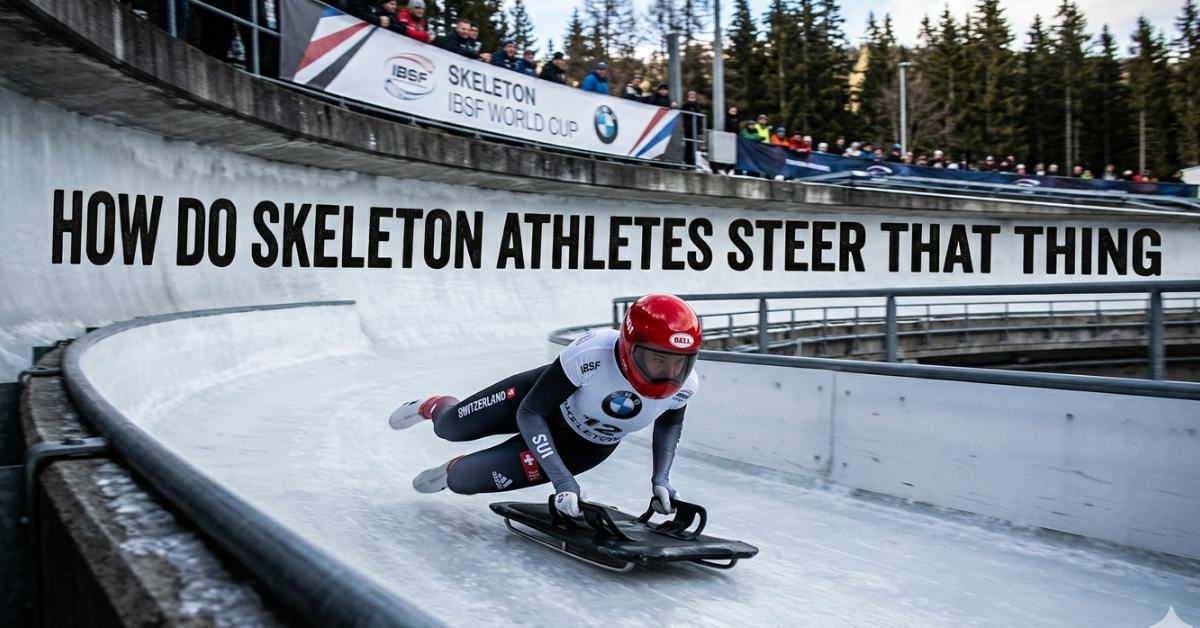

If you’ve ever watched the Winter Olympics, you’ve probably had the same thought as everyone else: how do skeleton athletes steer that thing while going face-first down an ice track at insane speeds?
It looks like they’re just lying flat on a tiny sled with no steering wheel, no brakes, and barely any control. And yet, they’re somehow making sharp turns at over 80 miles per hour.
So what’s actually going on?
Let’s break it down in a way that actually makes sense.
First, What Is Skeleton Racing?
Skeleton is a winter sliding sport where athletes:
- Lie face-down on a small sled
- Go headfirst down an icy track
- Reach speeds of 120–130 km/h (75–80 mph)
- Steer using only body movement
There are no handles, no steering wheel, and no brakes. Just the athlete, gravity, and precision control.
So How Do Skeleton Athletes Steer That Thing?
This is the big question: how do skeleton athletes steer that thing without any mechanical controls?
The answer is surprisingly simple—but extremely difficult to master.
They steer using tiny shifts in body weight and pressure on the sled’s runners.
1. Subtle Shoulder and Hip Movements
Athletes make micro-adjustments like:
- Shifting shoulders left or right
- Twisting the torso slightly
- Adjusting hip pressure on the sled
Even a few millimeters of movement can change direction at high speed.
2. Toe Pressure Control
Skeleton athletes wear special shoes with spikes, but they don’t use them to stop or push.
Instead, they:
- Press toes lightly into the ice at corners
- Create tiny friction differences
- Help guide direction through turns
It’s not obvious—but it matters a lot at high speed.
3. Steering Through the Sled’s Runners
The sled has two thin runners underneath.
When the athlete shifts weight:
- One runner gets slightly more pressure
- That runner digs differently into the ice
- The sled subtly turns
Think of it like steering a shopping cart—but at 80 mph on ice.
Why Steering Looks So Minimal (But Is So Precise)
At skeleton speeds, even small movements have huge effects.
Here’s why:
- Ice reduces friction dramatically
- Speed amplifies tiny directional changes
- Courses are designed with precise curves
- Overcorrecting leads to crashes
So athletes must stay extremely still while making micro-adjustments.
The Role of Track Memory (Yes, Really)
Top athletes don’t just react—they memorize the track.
They learn:
- Exact corner angles
- G-forces in each turn
- Ideal steering points
- Where to stay still vs. adjust
So instead of constantly reacting, they often steer in advance.
Training to Master Skeleton Steering
Becoming good at steering a skeleton sled takes years.
Physical Training
Athletes focus on:
- Core strength (for stability)
- Neck strength (to handle G-forces)
- Sprint speed (for initial push-off)
- Balance control
Technical Training
They also train:
- Track visualization
- Sled positioning drills
- Reaction timing
- Ice condition reading
Mental Training
This sport is just as mental:
- Staying calm at extreme speed
- Trusting muscle memory
- Avoiding panic corrections
Why It’s So Hard to Control
Skeleton is one of the most difficult sliding sports because:
- You’re face-first (limited visibility)
- You’re going extremely fast
- You have almost no direct control tools
- Mistakes happen in fractions of a second
A slight miscalculation can send the sled off-line instantly.
Skeleton vs Luge: Steering Difference
People often confuse skeleton with luge.
- Skeleton: Face-down, steering with shoulders/hips
- Luge: Face-up, steering with leg pressure
Skeleton steering is more subtle, but also more intuitive once mastered.
FAQs
1. How do skeleton athletes steer that thing without a steering wheel?
They steer using body weight shifts, shoulder movements, and pressure on the sled’s runners.
2. Do skeleton athletes have brakes?
No. They slow down after crossing the finish line using their feet.
3. Is skeleton more dangerous than bobsled?
It’s considered high-risk due to head-first position, but safety gear and training reduce danger.
4. How fast do skeleton athletes go?
Speeds can reach 120–130 km/h (75–80 mph).
5. Why do they go head-first?
It reduces air resistance and increases speed compared to feet-first positions.
Conclusion
So, how do skeleton athletes steer that thing? The answer is a mix of physics, precision, and incredible body control. There’s no steering wheel—just micro-adjustments in posture, pressure, and timing.
What looks like chaos at 80 mph is actually one of the most technically controlled sports in the Winter Olympics.
Once you understand the skill behind it, skeleton stops looking crazy—and starts looking like pure elite precision on ice.